Crisis-NG
Crisis-NG
For
ChapsVision - Paris, France
ChapsVision - Paris, France
Defense & Critical Infrastructure - NDA
Defense & Critical Infrastructure - NDA
Built for the people who plan crises. Used by the people inside one.
Built for the people who plan crises. Used by the people inside one.
Built for the people who plan crises. Used by the people inside one.
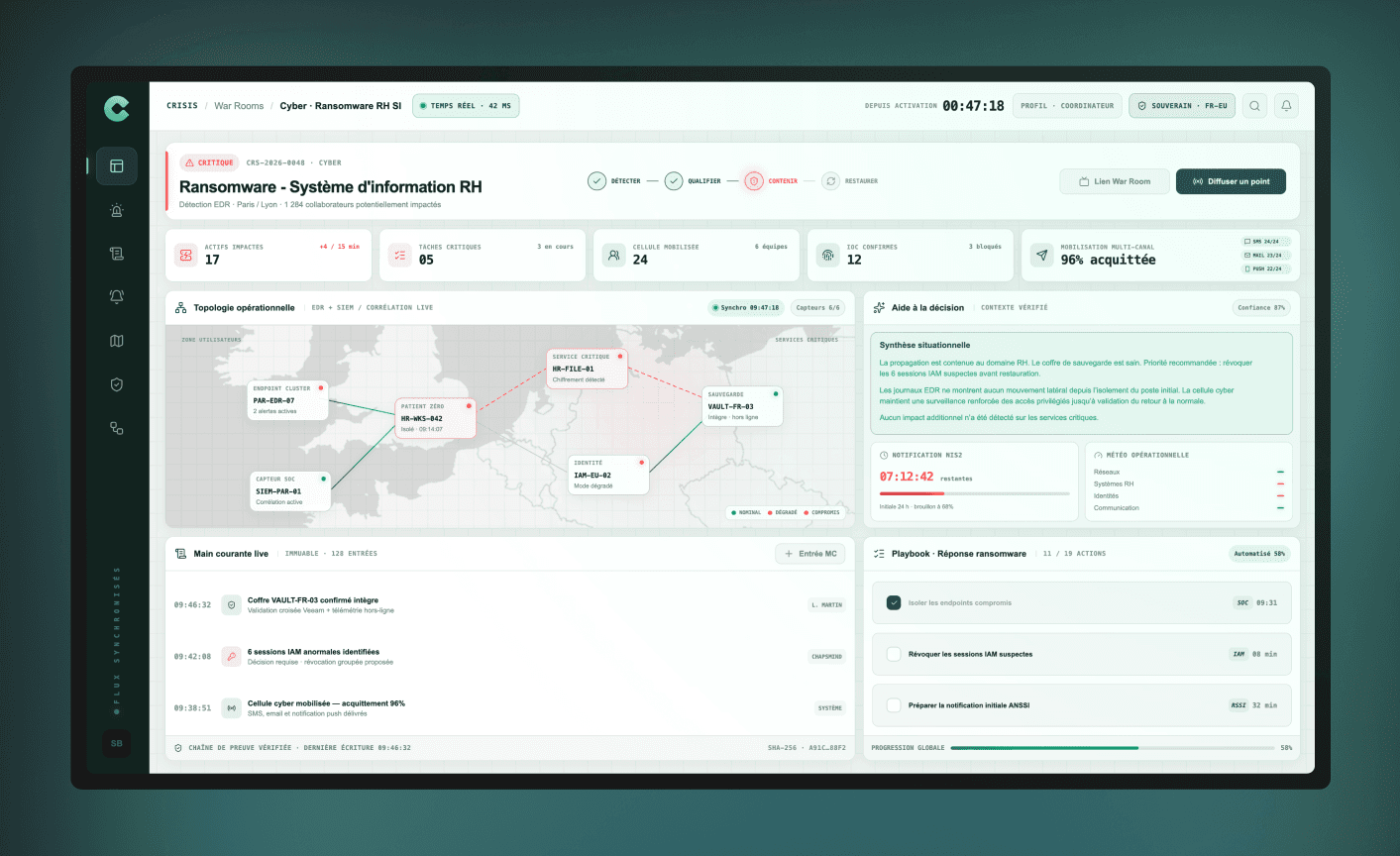
Crisis-NG is a next-generation crisis management platform, the system of record for how an organization opens a crisis cell, logs every decision, mobilizes its people, and proves afterward what was decided, by whom, and at what minute, across operators of vital importance, ministries, and critical-infrastructure groups in France. I ran the product design end to end on a rebuild where roughly 80% of the build was written by an AI agents, and where my role was the quality gate that loop did not have. This version walks the five modules that carry the operational story, "Main Courante, Tableau de Bord, Tâches & Décisions, Alertes, and RETEX, screen by screen, straight from the design envirenement.
Crisis-NG is a next-generation crisis management platform, the system of record for how an organization opens a crisis cell, logs every decision, mobilizes its people, and proves afterward what was decided, by whom, and at what minute, across operators of vital importance, ministries, and critical-infrastructure groups in France. I ran the product design end to end on a rebuild where roughly 80% of the build was written by an AI agents, and where my role was the quality gate that loop did not have. This version walks the five modules that carry the operational story, "Main Courante, Tableau de Bord, Tâches & Décisions, Alertes, and RETEX, screen by screen, straight from the design envirenement.
⦿ Role
Sole Product Designer / UX Engineer
⦿ Team
4 (Myself + PO, 2 Devs)
⦿ Timeline
May – Jul 2026

−62%
−62%
Of the elapsed time between when a crisis is formally declared and when the first decision gets logged.
92%
92%
Of first-time operators ran a complete crisis cell unassisted, no training session, no procedure manual.
6 crisis types
6 crisis types
Cyber, industrial, safety, health, reputational and natural, unified into one configurable cell model instead of six disconnected modules.
Regulation was the design brief
NIS2's 24-hour notification window, DORA incident reporting, ISO 22301 continuity records, SecNumCloud hosting constraints, RGPD and RGAA/WCAG 2.1 AA were treated as interaction requirements from day one, not as a compliance pass bolted on before the audit.
Regulation was the design brief
NIS2's 24-hour notification window, DORA incident reporting, ISO 22301 continuity records, SecNumCloud hosting constraints, RGPD and RGAA/WCAG 2.1 AA were treated as interaction requirements from the first wireframe, not as a compliance pass bolted on before the audit.
Context & Stakes
Context & Stakes
Six years in service, and almost nobody opened it.
Six years in service, and almost nobody opened it.
Crisis has been ChapsVision's crisis management platform since 2020, deployed across 34 organizations, energy and water operators, industrial groups, hospital networks, local authorities, and two ministries. It carries the logbook, the action plan, the document library, the mass-notification engine, and a world-risk map. On paper it covers the category. In 2025, across the entire installed base, the average client opened a crisis cell 2.3 times: twice for a drill, once for something real.
Crisis has been ChapsVision's crisis management platform since 2020, deployed across 34 organizations, energy and water operators, industrial groups, hospital networks, local authorities, and two ministries. It carries the logbook, the action plan, the document library, the mass-notification engine, and a world-risk map. On paper it covers the category. In 2025, across the entire installed base, the average client opened a crisis cell 2.3 times: twice for a drill, once for something real.
ChapsVision is a French software group for defense, cyber, and government, with an in-house Engineering Design Studio, six business units, and 20+ product lines. Crisis-NG sits in the Resilience line and was run as Initiative Tiger: rebuild the platform from zero with agentic engineering, on the majority of the implementation and not the full scope, and a designer embedded inside the delivery loop rather than upstream of it. I was allocated 80% to it. There was no Figma handoff, no mockup queue, and no staging environment for the first fourt weeks. I audited what the agent produced, wrote the corrective specs, designed the actual UX decisions in-flow, and shipped fixes in code before verifying and merging the result.
ChapsVision is a French software group for defense, cyber, and government, with an in-house Engineering Design Studio, six business units, and 20+ product lines. Crisis-NG sits in the Resilience line and was run as Initiative Tiger: rebuild the platform from zero with agentic engineering, on the majority of the implementation and not the full scope, and a designer embedded inside the delivery loop rather than upstream of it. I was allocated 80% to it. There was no Figma handoff, no mockup queue, and no staging environment for the first fourt weeks. I audited what the agent produced, wrote the corrective specs, designed the actual UX decisions in-flow, and shipped fixes in code before verifying and merging the result.
The legacy platform was not broken. It did what it was specified to do, and it did it for six years. But it was specified around the people who plan for crises, and it was bought by the people who have to survive one. Everything a crisis manager needed on a normal Tuesday, a plan to review, a document to file, a drill to schedule, all was there. Almost nothing was designed for 03:14 on a Sunday, when the person opening the cell has not touched the software since the last exercise, eleven months ago.
The Real Problem
The brief said "rebuild it faster." Speed was never the constraint.
The platform was designed for the people who plan crises. It was used by the people who are inside one.
NIS2 gives an operator of essential services 24 hours to notify a cyber incident, and ISO 22301 expects a defensible, timestamped record of every decision behind it. In the legacy product, none of that lived in the interface. It lived in the business continuity binder, in the head of whoever had run the last exercise, and in an Excel export somebody assembled afterward. A crisis pilot could open a cell, run it for nine hours, close it, and still not be able to answer the only question that matters at the post-incident review: who decided this, when, and on what information. The software would not stop them. Only the procedure would, and nobody reads a procedure at 3 a.m.
Due to confidentiality agreements, detailed product artifacts, workflows, architecture, and implementation cannot be published publicly. Qualified reviewers may request access for a guided walkthrough.
Due to confidentiality agreements, detailed product artifacts, workflows, architecture, and implementation cannot be published publicly. Qualified reviewers may request access for a guided walkthrough.
Reviewed manually · Avg. reply < 24h


Available for consulting & partnerships
Available for consulting & partnerships
The next project could be yours
The next project could be yours
I partner with startups, enterprises, and government teams to simplify complex systems, from strategy and design to production-ready delivery. If you're building something ambitious, let's talk.
I partner with startups, enterprises, and government teams to simplify complex systems, from strategy and design to production-ready delivery. If you're building something ambitious, let's talk.
